The Roles in a Food Chain
Every organism in an ecosystem plays one of several roles in how energy flows from one living thing to the next. These roles form the structure of every food chain on Earth.
Producers
Autotrophs- Plants that make their own food from sunlight through photosynthesis — the base of ALL food chains
- Convert the sun's energy into chemical energy (glucose) that other organisms can eat
- Examples: grass, trees, algae, seaweed, phytoplankton, wheat, corn
Primary Consumers
Herbivores- Animals that eat only plants — they get their energy directly from producers
- The first level of consumers in the food chain
- Examples: rabbit, deer, caterpillar, cow, grasshopper, elephant, zebra
Secondary Consumers
Carnivores & Omnivores- Animals that eat primary consumers — they get energy second-hand from producers
- Can be carnivores (eat only meat) or omnivores (eat both plants and animals)
- Examples: fox, frog, small fish, robin, snake, raccoon, bear
Tertiary Consumers
Apex Predators- Animals at the top of the food chain — they eat secondary consumers
- Often called top (or apex) predators — they sit at the top of the food chain and have few or no natural predators
- Examples: eagle, shark, lion, orca, tiger, wolf, crocodile
Decomposers
Nature's Recyclers- Break down dead plants and animals, returning nutrients to the soil
- Without decomposers, dead matter would pile up and nutrients would be locked away forever
- Examples: mushrooms, fungi and bacteria (true decomposers), plus earthworms, beetles and millipedes (detritivores that eat dead plant and animal remains)
Food Chain Examples
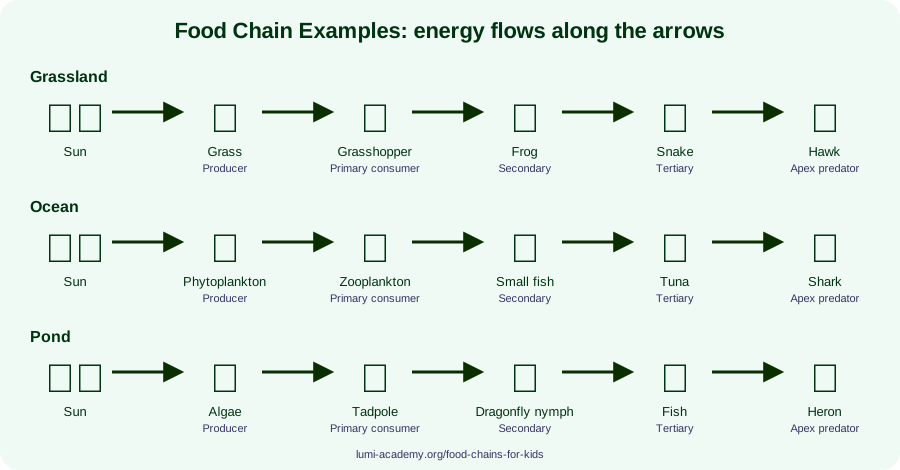
Here are 10 food chain examples from different ecosystems, from a simple grassland chain to the Antarctic ocean. Each one starts with the sun and a producer. Remember: the arrow means "is eaten by" or "energy flows to."
Grassland Chain
Prairie / Savanna- ☀️ Sun → 🌾 Grass (Producer)
- 🌾 Grass → 🦗 Grasshopper (Primary Consumer)
- 🦗 Grasshopper → 🐸 Frog (Secondary Consumer)
- 🐸 Frog → 🐍 Snake → 🦅 Hawk (Top Predator)
Ocean Chain
Open Ocean- ☀️ Sun → 🌿 Algae / Phytoplankton (Producer)
- 🌿 Algae → 🐟 Small Fish (Primary Consumer)
- 🐟 Small Fish → 🐠 Tuna (Secondary Consumer)
- 🐠 Tuna → 🦈 Shark (Tertiary / Apex Predator)
Forest Chain
Deciduous Forest- ☀️ Sun → 🍃 Oak Leaves (Producer)
- 🍃 Leaves → 🐛 Caterpillar (Primary Consumer)
- 🐛 Caterpillar → 🐦 Blue Jay (Secondary Consumer)
- 🐦 Blue Jay → 🦅 Red-tailed Hawk (Tertiary Consumer)
Desert Chain
Desert- ☀️ Sun → 🌿 Desert Grass Seeds (Producer)
- 🌿 Seeds → 🐭 Kangaroo Rat (Primary Consumer)
- 🐭 Kangaroo Rat → 🐍 Rattlesnake (Secondary Consumer)
- 🐍 Rattlesnake → 🦅 Red-tailed Hawk (Tertiary Consumer)
Pond Chain
Freshwater Pond- ☀️ Sun → 🌿 Algae (Producer)
- 🌿 Algae → 🐸 Tadpole (Primary Consumer)
- 🐸 Tadpole → 🐟 Bass (Secondary Consumer)
- 🐟 Bass → 🪿 Great Blue Heron (Tertiary Consumer)
Tundra Chain
Arctic Tundra- ☀️ Sun → 🌱 Tundra Grasses (Producer)
- 🌱 Grasses → 🐹 Lemming (Primary Consumer)
- 🐹 Lemming → 🦊 Arctic Fox (Secondary Consumer)
Rainforest Chain
Tropical Rainforest- ☀️ Sun → 🌳 Fig Tree Fruit (Producer)
- 🌳 Fruit → 🐒 Spider Monkey (Primary Consumer)
- 🐒 Spider Monkey → 🦅 Harpy Eagle (Secondary Consumer)
Backyard Garden Chain
Garden- ☀️ Sun → 🌹 Rose Leaves (Producer)
- 🌹 Leaves → 🐛 Aphid (Primary Consumer)
- 🐛 Aphid → 🐞 Ladybug (Secondary Consumer)
- 🐞 Ladybug → 🐦 Sparrow (Tertiary Consumer)
Farm Field Chain
Farm- ☀️ Sun → 🌾 Wheat (Producer)
- 🌾 Wheat Seeds → 🐁 Field Mouse (Primary Consumer)
- 🐁 Field Mouse → 🦉 Barn Owl (Secondary Consumer)
Antarctic Ocean Chain
Southern Ocean- ☀️ Sun → 🦠 Phytoplankton (Producer)
- 🦠 Phytoplankton → 🦐 Krill (Primary Consumer)
- 🦐 Krill → 🐧 Adélie Penguin (Secondary Consumer)
- 🐧 Penguin → 🦭 Leopard Seal (Tertiary Consumer)
Food Chain Questions
What are 10 examples of food chains?
Ten simple food chain examples: grass → grasshopper → frog → snake → hawk (grassland); algae → small fish → tuna → shark (ocean); oak leaves → caterpillar → blue jay → hawk (forest); desert seeds → kangaroo rat → rattlesnake → hawk (desert); algae → tadpole → bass → heron (pond); tundra grass → lemming → arctic fox (tundra); fig fruit → spider monkey → harpy eagle (rainforest); rose leaves → aphid → ladybug → sparrow (garden); wheat → field mouse → barn owl (farm); phytoplankton → krill → penguin → leopard seal (Antarctic).
What is a simple food chain example?
A simple food chain is grass → grasshopper → frog. The sun gives the grass energy, the grasshopper eats the grass, and the frog eats the grasshopper.
What does the arrow mean in a food chain?
The arrow points the way energy flows. It means "is eaten by", so grass → rabbit means the rabbit eats the grass.
What is always at the start of a food chain?
A producer, such as a plant or algae. Producers make their own food from sunlight, and the sun is the original source of energy for almost every food chain.
What are producers, consumers and decomposers?
Producers, like grass and algae, make their own food, usually with sunlight. Consumers get energy by eating other living things, and they can be plant-eaters, meat-eaters or both. Decomposers, like fungi and bacteria, break down dead plants and animals and return nutrients to the soil.
Why are there fewer animals at the top of a food chain?
Only about 10 percent of the energy at one level reaches the next level, on average, because the rest is used up or lost as heat. With less energy left at each step, there is only enough to support a few top predators.
Food Web vs. Food Chain
A food chain shows one straight path of energy — but in real ecosystems, most animals eat many different things and are eaten by many different predators. A food web connects all the overlapping food chains in an ecosystem, showing the true complexity of feeding relationships. A rabbit might be eaten by a fox, a hawk, an owl, a weasel, or a snake — and the rabbit itself eats many different plants. Real ecosystems are webs, not simple chains.
The Energy Pyramid: The 10% Rule
Energy is lost at every step of the food chain. On average, only about 10% of the energy at one level is passed on to the next level (it varies by ecosystem, roughly 5% to 20%). The rest is used by the organism for its own life processes (breathing, moving, staying warm), lost as heat, or left as waste and uneaten remains. This is why:
Level 1: Producers
100% Energy- Capture solar energy through photosynthesis — the starting point of all energy
- Support the largest biomass in any ecosystem — there must be a LOT of plants
- A grassland needs thousands of tons of grass to support its herbivores
Level 2: Herbivores
10% Energy- About 10% of the plants' energy becomes herbivore biomass
- Far fewer herbivores than plants in any ecosystem
- This is why you see far more grass than deer in a meadow
Level 3: Carnivores
1% Energy- About 10% of the herbivores' energy becomes carnivore biomass
- Much fewer carnivores than herbivores — this is why predators are rare
- A large territory is needed to support top predators like wolves and lions
Level 4: Apex Predators
0.1% Energy- About 10% of the carnivores' energy makes it to top predators
- Very few apex predators can be supported by any ecosystem
- Top predators need large areas to find enough food
What Happens When a Species is Removed?
When an apex predator disappears from an ecosystem, the effects ripple through every level — a phenomenon called a "trophic cascade." A famous example is Yellowstone National Park: the last wolf packs were gone by the mid-1920s, elk numbers grew, and overgrazing became a concern in some places. After wolves were brought back in 1995, scientists saw changes in where elk grazed and some streamside plants recovered. How much of that change came from the wolves is still debated, but it shows how one top predator can affect many other living things.
🌿 The Yellowstone Effect
Between 1995 and 1997, 41 wolves were brought back to Yellowstone National Park. Scientists have linked their return to changes across the park: elk changed where and how they grazed, some streamside willows and aspens grew back, and the number of beaver colonies increased. Researchers still debate how much of this the wolves caused and how much came from other factors like drought, bears, and human hunting, which is a great example of how scientists test big ideas.
Food Chain Facts
of energy is lost at each level of a food chain, on average — only about 10% transfers up to the next level
links in a typical food chain — because so much energy is lost at each step, chains rarely go much longer
of tiny bacteria can live in one teaspoon of healthy soil, working with fungi and worms as decomposers that recycle nutrients for new plants
Year wolves were reintroduced to Yellowstone — triggering one of the most studied trophic cascades
Sources & Further Reading
Want to learn more? These trusted sources are a good next stop for kids and grown-ups.
- Food Chain — National Geographic Education
- Energy Flow and the 10 Percent Rule — National Geographic Education
- Food Chains and Food Webs — U.S. Environmental Protection Agency
Learn More with Lumi Academy
Interactive lessons, quizzes, and games on food chains and hundreds of other subjects — one flat price for your whole family.
Start Free Trial →